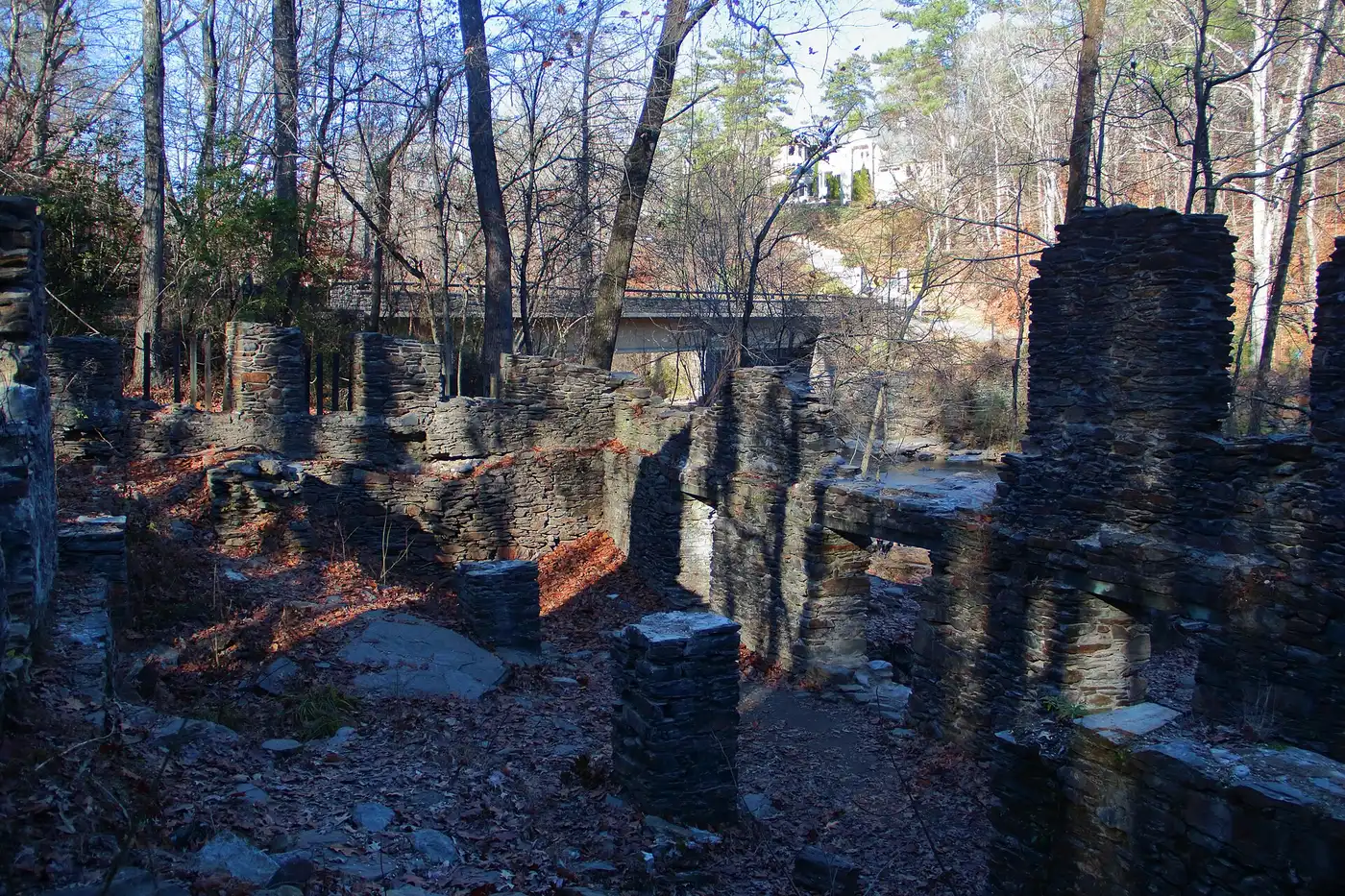
East Cobb was never incorporated. Its National Register sites: the Sope Creek mill ruins (listed 1973), the Power House (2001) and Power-Hyde Farm (2024).
Last checked Oct. 5, 2026. Dates come from the National Park Service’s National Register of Historic Places listings, the Park Service’s own history pages, Cobb County and Cobb Landmarks and Historical Society, each linked below. Cobb County historic preservation: 770-528-2010.
East Cobb has no founding date, because it was never incorporated as a town. It is the eastern part of unincorporated Cobb County. According to the county’s historic preservation office, the land was part of the Cherokee and Creek nations until the Georgia Legislature created Cobb County by an act in 1832. East Cobb’s oldest surviving landmarks date from that decade: farms and a family ferry along the Chattahoochee River, and a paper mill on Sope Creek.
Who to call
- Cobb County historic preservation planner: Mandy Elliott, 770-528-2010, mandy.elliott@cobbcounty.gov
- Chattahoochee River National Recreation Area (Sope Creek, Hyde Farm): 678-538-1200
- Cobb Landmarks and Historical Society: 678-594-4994, 80 N. Marietta Parkway NW, Marietta
National Register of Historic Places in East Cobb
From the National Park Service’s list of listed properties (spreadsheet), current to May 22, 2026:
| Property | Location | Listed |
|---|---|---|
| Sope Creek Ruins | Sope Creek, Chattahoochee River National Recreation Area (address restricted) | April 27, 1973 |
| George A. Power House | Hyde Road | July 11, 2001 |
| Power-Hyde Farm Historic District | 575 Hyde Road | Aug. 28, 2024 |
The Sope Creek mill
The ruins in the woods along Sope Creek are what remains of the Marietta Paper Mill, according to the National Park Service:
- Construction began in 1853 and paper production in 1855. The “rag mill” made writing, printing, tissue and wrapping paper from linen rags and old cotton.
- During the Civil War it was the largest paper mill in Georgia and made cartridge paper for Confederate guns. Union soldiers burned it on July 5 or 6, 1864; the Park Service says accounts differ on the date.
- It was rebuilt and running again by September 1868, partly burned again on Nov. 7, 1870, and later sold and renamed the Marietta Paper Manufacturing Company.
- It closed in 1902.
The ruins are in the Sope Creek area of the national recreation area, open dawn to dusk with a $5 daily pass. See our parks and trails guide for the trail map.
Hyde Farm and the Power family
Hyde Farm, on Hyde Road near Johnson Ferry, was settled by James Cooper Power in the 1830s on land that had been Cherokee territory, the National Park Service says. The original log cabin survives inside the Hyde farmhouse. From 1874, Power sharecropped with James Alexander Hyde, a Confederate veteran; Hyde’s son, Jesse Clifford Hyde, was born in 1881 about two miles from the Power cabin.
Cobb County says the farm was worked continuously from the 1830s until 2004. Cobb County, the National Park Service and the Trust for Public Land preserved it. Today Hyde Farm Park, 721 Hyde Road, covers 42 acres of a 135-acre historic property, with the log cabin, a barn, trails, a pond and community garden plots, according to Cobb PARKS.
Nearby, the Power Family Cabin is believed to have been built by George Abner Power, who married Winifred Copeland in 1843, according to Cobb Landmarks and Historical Society, which owns it. The society says James Power established one of the first ferries across the Chattahoochee around 1832, just south of what is now Cochran Shoals. The Trust for Public Land acquired the cabin’s land in 1996 and donated the cabin and 2.5 acres to Cobb Landmarks in 1999. The cabin is not regularly open; it can be visited during the society’s member events and scheduled tours.
Markers, surveys and cemeteries
- Historical markers: the Board of Commissioners started a county marker program in 2005. The county’s historical markers map shows every marker.
- Historic resources survey: the county surveyed about 875 historic properties in unincorporated Cobb in 2007; the survey report (PDF) and its indexes are online.
- Cemeteries: the Cobb County Cemetery Preservation Commission runs an Adopt-A-Cemetery program and takes reports of cemetery damage.
Museums near East Cobb
| Museum | Address | Hours as published | Phone |
|---|---|---|---|
| Marietta History Center | 1 Depot St., Marietta | 10 a.m. to 4 p.m. Tuesday through Saturday | 770-794-5710 |
| William Root House Museum and Garden | 145 Denmead St., Marietta | See the museum’s site | 770-426-4982 |
Cobb Landmarks says the Root House, which portrays middle-class life in the 1860s, is the oldest wood-frame building in downtown Marietta.
What this means for you
- The Sope Creek ruins are inside the national recreation area; bring the $5 daily pass and the Sope Creek trail map.
- Hyde Farm Park, 721 Hyde Road, is a Cobb County park with the 1830s log cabin and barn.
- Own an old house? Cobb Landmarks offers historic markers for eligible properties.
Related: East Cobb population and parks and trails.
Frequently asked questions
When was East Cobb founded?
East Cobb was never founded or incorporated as a town. It is an unincorporated part of Cobb County, which the Georgia Legislature created in 1832 from land that had been part of the Cherokee and Creek nations.
What are the Sope Creek ruins?
The remains of the Marietta Paper Mill, built starting in 1853. Union soldiers burned it in July 1864; it was rebuilt and closed for good in 1902. The ruins were listed on the National Register of Historic Places on April 27, 1973.
What is Hyde Farm in East Cobb?
A farm on Hyde Road settled in the 1830s and worked until 2004. Cobb County runs 42 acres of it as Hyde Farm Park, 721 Hyde Road, and the Power-Hyde Farm Historic District was listed on the National Register on Aug. 28, 2024.
Are there museums in East Cobb?
None is listed in East Cobb itself. The nearest are in downtown Marietta: the Marietta History Center, 1 Depot St., open 10 a.m. to 4 p.m. Tuesday through Saturday, and the William Root House Museum, 145 Denmead St.
Have your say